Spider Solitaire
- 4.6
- Rating
- 1.00M
- Installs
- Free
- Price
 Analysis by App-foxy
I spent time with Spider Solitaire as the kind of card game you open when you want something familiar, quiet, and easy to control. My overall impression is clear: this is a practical version of the classic solitaire format, built more around comfortable play than flashy presentation. The cards are the main event, the rules are recognizable, and a short session can fit naturally into a coffee break, a waiting room, or the last few minutes before bed.
That simplicity is also the reason I would not recommend it to everyone. If you want a deep collection of card games, competitive online play, dramatic visuals, or a constant stream of new systems to learn, this particular game may feel limited. If you want a readable Spider Solitaire experience that does not ask much from you before the first move, it makes a stronger case.
A calm card game that puts readability first
Spider Solitaire is a free card game from Solitaire Classic Fun. It sits in the familiar casual-card corner of mobile gaming, where the appeal comes from arranging cards, spotting a useful sequence, and gradually clearing the table. The game is suitable for Everyone, so it is an approachable choice for family members who want a straightforward pastime rather than a complicated strategy title.
You May Also Like

 Blood Strike: 2.5 Anniversary
Blood Strike’s Loadouts Turn Every Drop Into a Tactical Gamble
A close look at Blood Strike’s custom loadouts: how fast access to signature weapons reshapes its battle royale rhythm, rewards preparation, and narrows the gap between fights.

 Pandora - Music & Podcasts
Pandora’s Music Is Easy to Start, but Harder to Recover
Pandora’s strength is its low-effort path from a seed to a station. Its weak spot is how much confidence it asks you to place in connection, setup, and quiet recovery.

 8 Ball Pool
 Is Built on Rivalries, Rematches, and Routine
A close look at the rivalries, rematches, shared routines, and unanswered safety questions that turn a quick pool match into a persistent mobile community.

 Samsung Music
’s Quiet Strength Is Playing What You Already Own
Its reach comes less from spectacle than from dependable access to a personal library. That simplicity is both the app’s strongest retention engine and its ceiling.

 AccuWeather: Weather Radar
AccuWeather Review: A Quick, Clear Forecast for Everyday Decisions
For everyday plans, the best forecast is the one you can understand quickly. AccuWeather makes rain timing, radar, and local conditions easy to act on, with a few trade-offs.

 Hill Climb Racing
Why Hill Climb Racing Still Turns Crashes Into One More Run
A tiny car, a bumpy hill and one more upgrade: Hill Climb Racing keeps resurfacing because its simple chaos makes every near-miss feel personal.
More From Our News Desk



The first thing I noticed was how naturally the format suits touch controls. Spider Solitaire depends on moving cards between columns, and that makes every action feel deliberate. You are not trying to react at high speed. You are looking at the available cards, deciding which move preserves flexibility, and then placing a card where it can help uncover the next option.
That pace gives the game a useful quality that many mobile distractions lack: it leaves room for thought. I can play for a few minutes without feeling pulled into a noisy reward loop, and I can stop after a single deal without losing the sense that the session had a purpose. The experience is especially comfortable for people who enjoy puzzles but do not want a demanding brainteaser.
The developer’s focus is visible in the straightforward identity of the game. It is not trying to turn Spider Solitaire into an adventure or a social platform. Instead, it stays close to the card-table idea, which helps anyone already familiar with the rules settle in quickly. The store’s emphasis on larger cards also points toward its most obvious audience: players who value visibility and uncomplicated interaction.
What makes the card layout work well
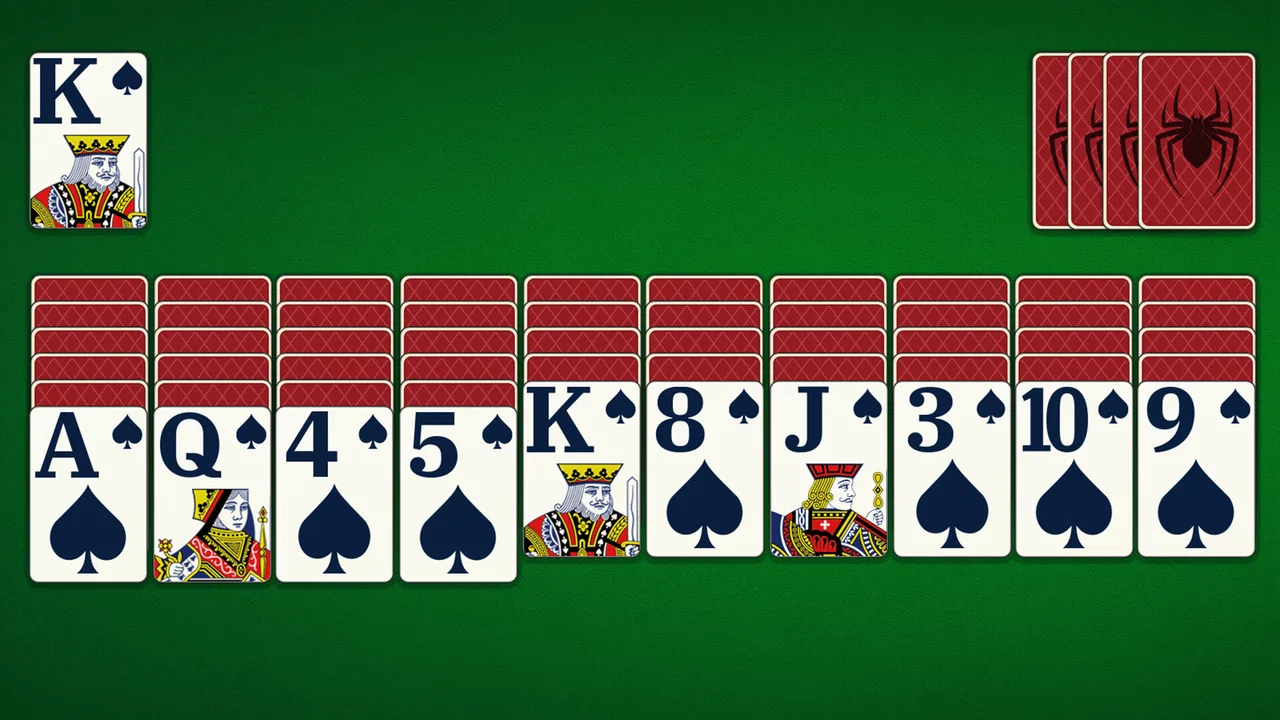
For me, the strongest part of the experience is the relationship between the layout and the decision-making. Spider Solitaire is not only about finding a legal move. It is about choosing whether to expose a hidden card, build a longer sequence, or keep a column available for later. A readable arrangement matters because one missed card or awkward touch can change the entire rhythm of a deal.
The larger-card approach is useful beyond older players. Anyone playing on a smaller phone, using the game while tired, or dealing with bright outdoor light can benefit from a layout that does not make every card a visual inspection task. I also found that larger cards make the game more suitable for shared use. If I hand the phone to someone who is less comfortable with mobile controls, the board is easier to explain without constantly zooming or pointing.
There is a subtle advantage to this kind of design: it reduces the mental cost of operating the game, leaving more attention for the puzzle itself. That matters in Spider Solitaire because the challenge is already created by the order of the cards. A cramped interface would add frustration without adding strategy.
Another strength is the game’s flexible session length. I can make a few thoughtful moves while waiting for an appointment, or continue longer when I want a more absorbing quiet activity. It does not require a large block of free time, and that makes it more realistic for everyday use than many games that advertise themselves as casual but still expect sustained attention.
A useful routine for short breaks
One realistic way to use it is as a replacement for aimless scrolling. Suppose I have ten minutes before leaving the house or while waiting for a meal. Instead of opening several noisy apps, I can start a deal, focus on the columns, and stop when the time is up. The game gives the break a clear beginning and end, while still offering enough planning to feel more engaging than simply watching content.
I also think it can work well as a gentle evening activity. The turn-based pace does not demand quick reflexes, and the familiar card structure is easy to return to after a busy day. That said, players who become frustrated by an unlucky or difficult deal may find it less relaxing than expected. The calm presentation does not remove the need to accept that some positions require patience and that not every move will produce an immediate improvement.
For older relatives, the game could be a comfortable introduction to playing cards on a phone, especially if physical cards are inconvenient or a table is not available. I would still recommend showing them the controls once rather than assuming every touch gesture is obvious. Large cards help with recognition, but readable cards do not automatically explain every interaction to a first-time mobile player.
The strategy is simple to learn but not empty
Spider Solitaire is accessible, yet it rewards better habits than random tapping. My most useful approach was to treat empty spaces as valuable resources. A cleared column can give you room to move a sequence, but using that space too quickly can also leave the board harder to manage. I try to expose hidden cards when possible while avoiding moves that lock useful sequences behind a temporary arrangement.
A second practical habit is to look for moves that create options rather than moves that merely look tidy. Building a neat visible stack can feel satisfying, but it is not always the best choice if it prevents access to a face-down card. When I pause to compare two legal moves, I usually favor the one that opens the board or preserves more destinations for later cards.
A third tip is to avoid treating every available move as equally urgent. In a relaxed game, there is value in scanning the whole layout before committing. I look for sequences that can be moved together, columns that are close to becoming useful, and cards that might be buried if I choose the obvious move first. This small pause changes the game from simple card placement into a modest planning exercise.
These habits are also why the game can appeal to people looking for light mental exercise. I would not describe it as a serious training tool, but it does encourage visual tracking, sequencing, and delayed decisions. The benefit comes from paying attention to the board, not from rushing through deals or tapping every highlighted possibility.
Where it fits among other solitaire choices
Compared with ordinary Klondike Solitaire, Spider Solitaire feels more focused on building and reorganizing sequences across several columns. Players who prefer the familiar red-and-black alternating pattern of Klondike may need a little time to adjust to Spider’s different logic. In return, Spider offers a more involved table to manage, which can make each deal feel less automatic once the basic rules are understood.
Compared with a broad solitaire collection, this game is narrower. A collection is better if I want to switch between Klondike, FreeCell, Pyramid, and other formats without installing or learning another app. Spider Solitaire is better when I already know which card game I want and prefer a direct route to it. That narrower focus is a strength for clarity but a weakness for variety.
It also differs from competitive card apps. There is no reason to choose this experience if the main attraction for you is ranking against other players, live matches, chat, or a strong social layer. Its appeal is private concentration. I can play at my own pace, make a mistake, reconsider a position, and continue without feeling watched or timed.
Against heavily decorated casual games, the restrained approach is refreshing, but it may look plain to players who expect animated backgrounds, collectible themes, or a steady stream of visual rewards. I personally prefer not having those elements compete with the cards, yet I understand why someone seeking spectacle might find the presentation too modest.
Who is likely to enjoy it most
I would recommend this game first to people who already like Spider Solitaire in physical form and want the same basic pastime on a phone. It is also a good fit for players who want a low-pressure puzzle between other activities, older users who benefit from larger cards, and beginners who would rather master one recognizable format than navigate a large menu of games.
It suits a player who values control over pace. You can think through a move instead of reacting instantly, and the game works well when your attention is available in short pieces. It is also a sensible choice for someone seeking a free card game with an Everyone age rating and a simple purpose rather than a broader entertainment package.
I would be more cautious about recommending it to someone who quickly loses interest without new content. The core loop is intentionally repetitive: arrange cards, uncover possibilities, and work toward clearing the layout. That repetition is comforting for fans, but it can feel narrow if you need constant changes in rules or presentation.
It is also not my first choice for a player who wants a demanding competitive challenge. Even if you enjoy strategy, you may prefer a title with deeper difficulty controls, detailed performance tracking, or several distinct modes. This game’s value is in its approachable card-table routine, not in turning every session into a high-pressure test.
What to expect from installation and compatibility
The game has been available since March twentieth, twenty twenty, and its current version is 1.22.265. It runs on Android seven point zero or later, which gives it a fairly broad compatibility range for Android users with older devices. Before installing, I would still check the operating system on the phone you plan to use, especially if it is an older handset that has not received recent updates.
Its free price makes trying it easy, and the game’s established audience suggests that it has found a substantial place among mobile card players. It has passed one million installs, with an average rating of four point six from around ten thousand ratings and roughly two thousand four hundred written reviews. I see those figures as useful context rather than a substitute for personal fit: a popular, well-regarded card game can still be the wrong choice if you need variety or competition.
The developer is listed as Solitaire Classic Fun, a name that matches the focused nature of the app. I would approach the download with the same practical expectation I bring to any simple card game: install it for the core activity, not because I expect a large entertainment ecosystem around it. That expectation makes the experience easier to judge fairly.
Small limitations that affect the decision
The biggest limitation is the narrow scope. When I want only Spider Solitaire, that focus is convenient. When I want to move from one card format to another, it becomes a reason to choose a different app. A larger solitaire suite would offer more ways to keep playing after a particular deal stops feeling fresh.
The second limitation is that the game’s simplicity may not satisfy players who want extensive customization. I would not choose it expecting the level of personalization associated with premium card-table apps or feature-heavy collections. Its clean, direct approach is part of the appeal, but it also means there is less to explore outside the main board.
There is also a human limitation rather than a technical one: large cards solve readability problems, but they cannot solve poor playing habits. If I move without scanning the columns, I can still create a dead-end position. New players should give themselves permission to pause and study the board instead of assuming that the fastest legal move is the best move.
Finally, the game is best enjoyed when I accept its quiet pace. Anyone looking for instant stimulation may mistake the lack of noise for a lack of substance. The strategy is modest, but it becomes more satisfying when I treat each deal as a small planning problem instead of a sequence of taps.
My verdict for everyday play
After using it, I see Spider Solitaire as a dependable, focused card game rather than an ambitious all-purpose gaming app. Its best qualities are the readable card presentation, the familiar rules, the relaxed pace, and the way it turns a short idle moment into a small exercise in planning. Those qualities make it particularly suitable for seniors, beginners, and anyone who wants a quiet game that can be picked up and put down easily.
The key trade-off is simple: you get a comfortable Spider Solitaire routine, but not a wide world of card-game variety. I would choose it when I know exactly what I want to play and prefer clear cards over decorative distractions. I would skip it in favor of a larger collection when switching between solitaire formats matters more than a focused interface.
For a friend asking whether it is worth trying, my answer would be yes, provided Spider Solitaire itself is the attraction. The free entry point removes much of the risk, the age rating makes it broadly approachable, and the established reception gives it reasonable credibility. Just install it with the right expectations: this is a calm, practical card-table companion, not a competitive platform or a constantly changing puzzle catalogue.
In my experience, that modest goal is exactly why it works. A few minutes of careful card movement can be enough to reset my attention, and the game does not need elaborate extras to make that small routine worthwhile. If you enjoy the Spider format and want a readable Android version, this is an easy recommendation; if you need novelty above all else, look toward a broader alternative.
FAQs for Spider Solitaire
01Is Spider Solitaire free to download and play?
Yes, Spider Solitaire is free to download and play on both Android and iOS platforms. However, it may offer in-app purchases or ads to enhance the user experience or remove advertisements. Be sure to check the app details on your respective store to understand any costs involved.
02What are the system requirements for Spider Solitaire?
Spider Solitaire typically requires a basic level of system resources to run smoothly. For Android, a device running Android 4.4 or higher is usually needed. For iOS, the app generally supports iOS 9.0 or later. Always check the specific app version for exact requirements as they can vary.
03Can I play Spider Solitaire offline?
Yes, one of the advantages of Spider Solitaire is that it can be played offline. This makes it an excellent choice for users who want to enjoy a game without needing a constant internet connection. However, some features, such as leaderboards or updates, may require internet access.
04Are there different difficulty levels in Spider Solitaire?
Absolutely, Spider Solitaire offers various difficulty levels, typically including one suit (easiest), two suits (medium), and four suits (hardest). This allows players to choose a level that matches their skill and challenge preference, making the game suitable for both beginners and advanced players.
05How can I remove ads from Spider Solitaire?
To remove ads, Spider Solitaire usually offers an in-app purchase option. This purchase can provide an ad-free experience and may also include additional features or bonuses. Check the app’s settings or store page for detailed information on purchasing options and pricing.
Pros
- Intuitive interface easy to navigate.
- Multiple difficulty levels for all players.
- Minimal ads for uninterrupted gameplay.
- Customizable card backs and themes.
- Offline play available for on-the-go fun.
Cons
- Limited daily challenges available.
- No multiplayer mode for competitive play.
- Card animations can be slightly laggy.
- In-app purchases for additional features.
- Ads can appear between game sessions.

Spider Solitaire
Gallery